

Retail has never stood still, but 2026 marks a clear turning point.
Shoppers are more informed, more selective and more demanding than ever before. They expect experiences that feel personal, seamless and aligned with their values, whether they’re browsing online, walking into a store or chatting with an AI shopping assistant. At the same time, retailers are under pressure to do more with less, balancing elevated costs and increasingly complex operations.
The retailers that win in 2026 won’t just react to change. They’ll design for it.
From AI-led decision-making to experiential retail and smarter loyalty strategies, these are nine of the most anticipated retail trends shaping the year ahead and what they mean for your business.
1. Customers are turning to AI to research purchases
Product discovery doesn’t just start in the search bar anymore.
Instead of scrolling through pages of links, shoppers are increasingly turning to conversational AI and specialized research platforms to help them decide what to buy. And these tools don’t just show users products, they help guide decisions. They ask follow-up questions, compare options side by side and tailor recommendations based on context, preferences and budget.
This may be marking a major shift in retail trends. Until recently, AI in retail was largely confined to post-purchase support: chatbots answering FAQs or tracking orders. In 2026, generative AI is influencing the buying decision before it happens.
An AI shopping assistant might recommend products based on lifestyle needs, simulate how an item performs in real-world conditions or even “test” products on a shopper’s behalf using AI agents. This is conversational commerce at work. It’s shopping that feels less transactional and more consultative.
For retailers, the implication is clear: discovery is becoming dialogue-driven. The brands that show up with relevant, structured product information—and can support AI-led experiences—can be the ones customers trust during the research phase, not just at checkout.
2. Experiential retail will increasingly attract shoppers
Physical stores are being redefined by experiential retail.
Experiential retail includes workshops, 1:1 consultations, product demos, exclusive events and personalized service—all designed to give shoppers a reason to visit beyond mere convenience.
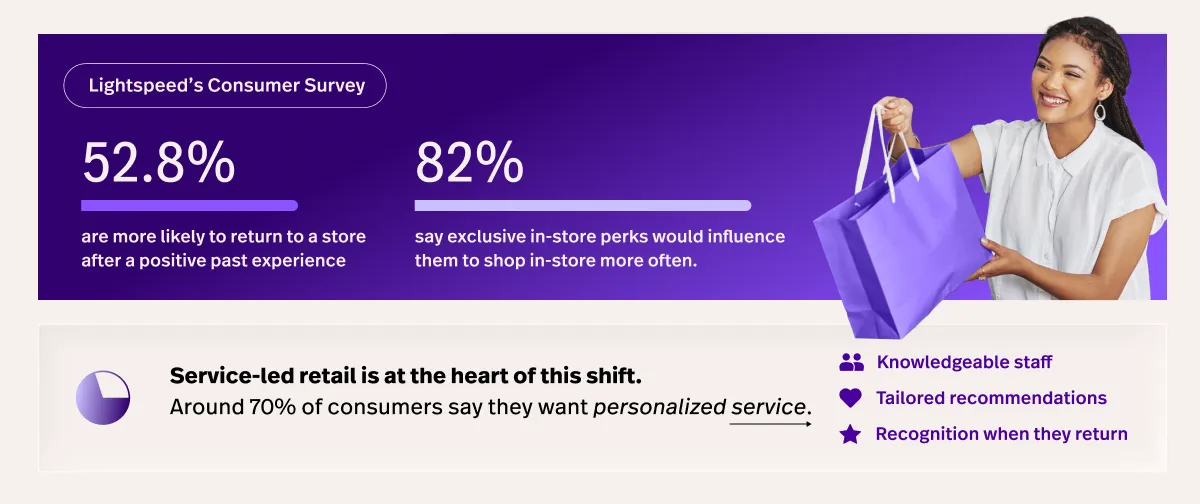
Increasingly, stores are becoming retail community hubs rather than just places to transact, and consumers are responding: According to Lightspeed’s FY26 Retail Consumer Survey, 52.8% of shoppers are more likely to return to a store after a positive past experience, while 82% say exclusive in-store perks would influence them to shop in-store more often.
Service-led retail is at the heart of this shift. Around 70% of consumers say they want personalized service, whether that’s knowledgeable staff, tailored recommendations or recognition when they return.
In an era where nearly anything can be delivered tomorrow, experience is the differentiator ecommerce can’t fully replicate. Retailers that invest in meaningful, human interactions can both increase foot traffic and build long-term, emotionally-driven loyalty.
3. AI-powered analytics will help drive business decisions
Retail data has long been plentiful, but not always easily actionable.
In 2026, that can change. Retailers are moving beyond descriptive dashboards and toward predictive and prescriptive analytics, where AI tools can explain what happened and show you what to do next.
Predictive analytics also enables micro-level demand forecasting, factoring in seasonality, local trends, promotions and real-time sales. This matters because 35.1% of consumers cite poor product selection as a reason for a negative in-store experience, and 37.7% want real-time inventory updates.
AI is also powering dynamic pricing, allowing retailers like Uber and Amazon to adjust prices automatically based on factors like demand, competition or inventory levels. What’s more, merchandising decisions—what to promote, discount or retire—are increasingly automated, helping retailers protect margins while staying relevant.
Even fraud prevention is becoming more effective, with AI that’s able to flag suspicious activity as it happens.
In short, AI in retail is shifting from insight to action. Retailers that take advantage of this opportunity can come out ahead of the pack.
4. Sustainability continues to be top of mind
Sustainability in retail is no longer a niche differentiator; it’s become more of an expectation, especially for Gen Z shoppers.
Shoppers are paying closer attention to how products are sourced, packaged, transported and reused, and they’re holding brands accountable.
One major shift is the rise of the circular economy. Rental, resale and repair models are moving into the mainstream, offering consumers flexibility while helping to reduce waste. These models also unlock new revenue streams and extend product lifecycles, offering incentives for both shoppers and retailers.
Importantly, many consumers are willing to pay more for a product from brands they trust. Purpose-led brands that invest in ethical sourcing, transparent supply chains and sustainable packaging can earn loyalty, not just attention.
In 2026, sustainability is in, and it means aligning business practices with consumer principles in a way that’s visible—and most importantly—credible.
5. Wholesale and retail integration as a competitive advantage
Buying inventory has traditionally been one of the most manual, fragmented parts of retail operations. Retailers juggle supplier portals, spreadsheets, emails and disconnected systems just to place orders and get products on the floor. In 2026, that model can become a liability.
Retailers are turning to integrated wholesale tools that connect suppliers directly to their POS. This gives buyers a single, real-time view of products, pricing, availability and performance without having to leave the system they already use to run their business.
The payoff can be significant. Integrated wholesale purchasing reduces administrative work, minimizes data entry errors and speeds up time-to-floor. When rich product data flows automatically from supplier to POS, retailers can merchandise faster, launch products sooner and respond more quickly to demand. This approach also supports better inventory decisions. With wholesale orders connected to real-time sales data, retailers can buy more confidently, reorder top performers sooner and avoid overstocking slow-moving items.
Lightspeed customers are already seeing the impact. Using Lightspeed Wholesale, retailers like CBS Sports can browse and buy from their preferred suppliers directly within their POS, syncing product details to their stores with a few clicks.
For Squash Blossom Boutique, this integration has dramatically reduced operational overhead.
“Using [Lightspeed Wholesale] has cut my data entry for purchase orders down by 80%.” — Lisa Bobb, Owner of Squash Blossom Boutique
As wholesale buying becomes more data-driven and automated, retailers that modernize how they source inventory can gain a clear edge. Less time spent managing orders means more time spent merchandising, selling and serving customers.
6. Consumers will continue to be value-conscious
Value still matters, but it doesn’t mean “cheap.”
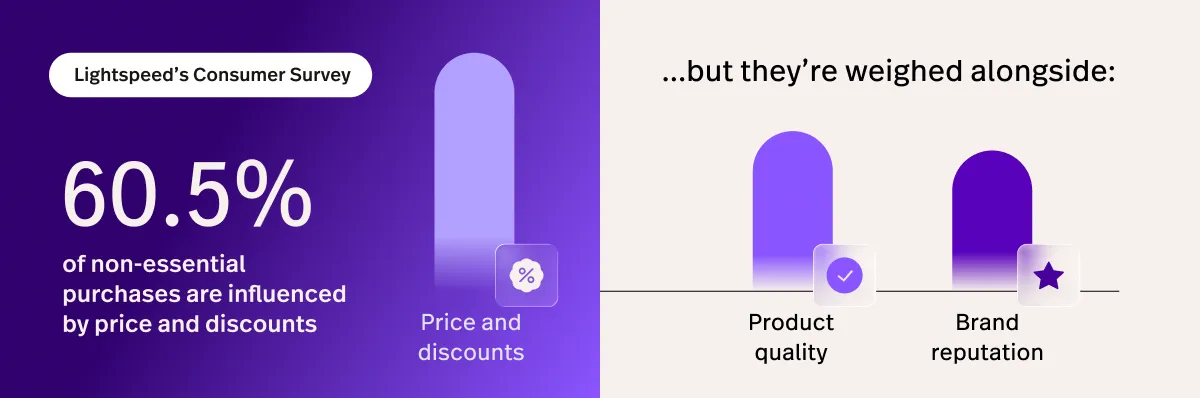
Shoppers could be getting more strategic with their spending this year. Economic pressure has made consumers more selective and more discerning, with multiple factors influencing their purchasing decisions. Price and discounts influence 60.5% of non-essential purchases, but they’re weighed alongside product quality (43.8%) and brand reputation as well (38.5%).
Shoppers may be willing to pay more when the value is clear and the brand is credible. This has big implications for discount strategies. Blanket promotions can erode brand value, while targeted offers tied to quality, durability or loyalty feel more intentional.
For retailers, the opportunity lies in clearly communicating why a product is worth its price, and reinforcing brand value at every touchpoint.
7. Personalization and rewards driving loyalty
Shoppers aren’t paying attention to just any old loyalty program anymore. In 2026, it may take more to get customers excited about loyalty–namely more personalization and in-person experience.
Nearly 70% of consumers want more personalized service from their retailers, and this applies to loyalty programs, too. Paid memberships can be a strategic revenue driver, for example, offering exclusive perks that go beyond discounts: early access, VIP events, free services or in-store experiences. These programs create commitment while giving retailers predictable revenue.
In-store rewards matter too. 40.3% of consumers say they return for loyalty rewards only available in-store, reinforcing the idea that loyalty is about experience, not just savings.
Lightspeed helps you deliver on these expectations with advanced marketing capabilities built right into your POS for stronger customer relationships across the board. Collect customer data to personalize service, and automate segmentation and communications. Create loyalty & reward programs with targeted offers that truly speak to your audiences and keep them coming back.
8. Online convenience will be expected in physical stores
Shoppers don’t separate their online and offline experiences. They expect both to be seamless and intertwined.
In 2026, omnichannel retail means bringing online convenience into the store. Customers want transparency, speed and information regardless of where they shop.
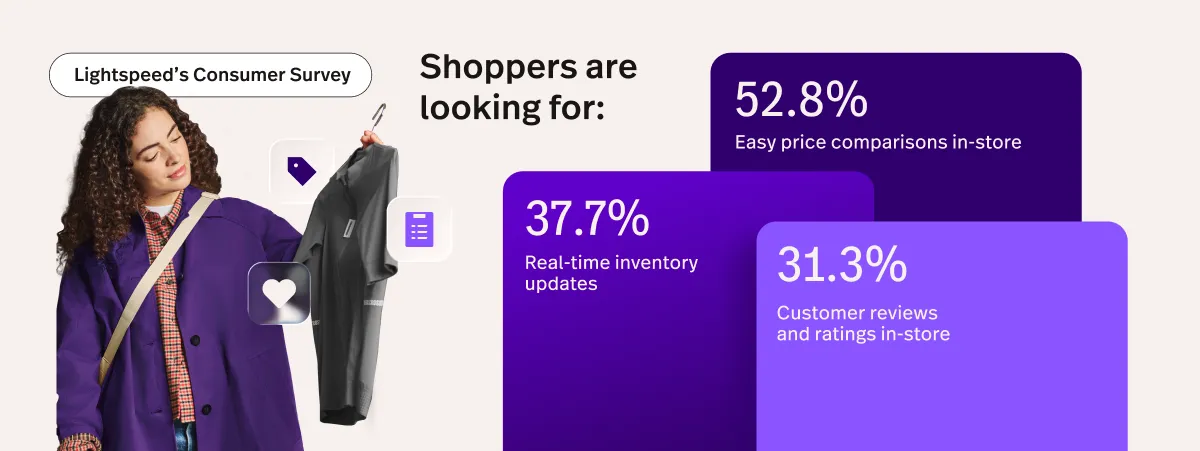
According to Lightspeed’s Consumer Survey, shoppers are looking for:
- Easy price comparisons in-store (52.8%)
- Real-time inventory updates (37.7%)
- Customer reviews and ratings in-store (31.3%)
Technology is something that can make this possible. For example, mobile selling, clienteling tools and digital in-store experiences allow staff to answer questions instantly, complete sales anywhere and personalize interactions in real time.
9. AI-powered back-office tools can free up retailers to focus on the customer
Some of the most important retail innovation in 2026 is happening behind the scenes.
Retail automation is transforming inventory management, finance, logistics and workforce planning, helping retailers reduce errors, lower costs and improve speed. Specifically, AI-driven demand forecasting and assortment planning can help retailers stock the right products at the right time, while supply chain AI can flag disruptions before they impact customers.
This matters because back-office efficiency directly affects the customer experience. 51.5% of consumers cite long lines or slow service as their top frustration, and those issues often stem from operational bottlenecks.
When AI handles repetitive tasks and connects data across systems, staff can focus where it counts: on the customer. Faster checkouts, better availability and more engaged teams all stem from stronger back-office foundations.
Stay ahead of 2026 retail trends with Lightspeed
Retail in 2026 is defined by convergence: technology and humanity, efficiency and experience, value and trust.
To be able to thrive this year, retailers can consider investing in technology-powered insight, experiential retail, unified commerce and personalization—not as separate initiatives, but as part of a connected strategy.
With the right foundation, retailers can move faster, serve customers better and adapt with confidence no matter what the market brings next.
The future of retail isn’t just coming. It’s already here.
Stay ahead of trends, streamline operations and unlock your growth potential with Lightspeed. Talk to one of our product experts to learn how.
Lightspeed initiated a consumer survey in June 2025 using a third-party survey vendor UserTesting. Over 380 responses were collected in the United States and Canada. Respondents were required to have made a purchase from a retail store two to three times (not including groceries) in a month.