

Ending inventory is more than just the value of unsold goods sitting in your stockroom at the end of an accounting period; it’s a key number that directly impacts your financial statements and sheds light on how well your inventory is performing. Whether you run a single shop or manage multiple stores, keeping this figure accurate is key to staying on top of your operations.
Understanding your ending inventory means knowing your cost of goods sold and what’s left to sell. That clarity helps you make smarter purchasing decisions, avoid overstock and keep cash flow steady. In other words, it’s how you stay efficient while meeting customer demand.
When you calculate and track ending inventory properly, it keeps your reporting accurate and your business competitive.
Table of contents
Grow your retail business.
Streamline inventory, suppliers, teams and stores with Lightspeed’s all-in-one platform. From intuitive POS and stock management features to powerful reporting, Lightspeed gives you the tools you need to grow.
Ending inventory explained
In a nutshell, ending inventory is what’s left unsold at the end of an accounting period. It’s a key number that ties together your inventory cycle—starting inventory, purchases and sales. Beyond tracking what’s on your shelves, it directly impacts the cost of goods sold (COGS) and gives insight into the health of your stock management.
The makeup of ending inventory differs by business. It might include finished goods ready for sale, raw materials waiting to be used or work-in-progress items that aren’t quite complete. Together, these pieces represent a significant asset on your balance sheet.
To keep your ending inventory accurate, you need consistent tracking throughout the period. That means accounting for what’s been sold, what’s been purchased and any losses from shrinkage or returns. Getting this right isn’t just about balancing the numbers—it ensures you’re making informed decisions for your business.
Why is ending inventory important?
Financial reporting
Ending inventory is a key number for accurate financial reporting. It directly affects how you calculate the COGS—the figure subtracted from revenue to get gross profit. Because ending inventory is listed as a current asset on the balance sheet, any errors can throw off your income statement and distort your financial position.
Tax purposes
Ending inventory has a direct impact on taxable income. When the value of your ending inventory is higher, COGS decreases, which increases your net income—and your tax liability. On the other hand, undervaluing inventory might lower taxes in the short term but can lead to problems during audits, making accuracy a must.
Inventory management
Ending inventory is also a powerful tool for inventory management. It shows whether you have too much or too little inventory on hand, helping you avoid overstocking, waste and stockouts. With clear numbers, you can plan smarter purchases, keep cash flow steady and ensure you have the right products available when your customers actually need them.
How is ending inventory used?
Income statements
Ending inventory directly affects the COGS, which is a key figure for calculating gross profit and net income. To determine the ending inventory formula, you subtract ending inventory from the total goods available for sale. A higher ending inventory lowers COGS and boosts gross profit, while a lower figure does the opposite: raising costs and cutting into profits.
Getting this number right ensures your income statements accurately reflect the performance of your business. Inflated inventory values can overstate profits, while understated values may create the illusion of losses. Precision here isn’t optional—it’s the foundation for actionable financial reports and smarter growth decisions.
Balance sheets
On the balance sheet, ending inventory appears as a current asset—it’s the value of goods still available for sale. This figure isn’t just for show as it contributes to working capital, which measures liquidity and operational efficiency. Accurate reporting keeps your balance sheet aligned with reality.
Overvaluing inventory can make your business look healthier than it is, misleading investors or stakeholders. On the other hand, undervaluing inventory could limit financing opportunities or suggest solvency issues. Reliable inventory values build trust and present a clear financial picture.
Inventory turnover ratio
Ending inventory also drives the inventory turnover ratio, which is a measure of how effectively your stock moves. The formula is simple: divide COGS by the average inventory during the period. Lower ending inventory typically means a higher turnover ratio, signaling efficient sales.
This ratio highlights slow-moving products and helps refine buying strategies. It’s a way to keep inventory lean, reduce carrying costs and improve cash flow. With the right tools—like Lightspeed’s retail POS system that tracks inventory in real time—you can maintain accuracy, prevent stockouts or overstocking and ensure you always have the right products available when customers need them. Ending inventory isn’t just a number on a spreadsheet—it’s a pulse check on how well your business is managing its stock.
How to calculate ending inventory
The formula for calculating ending inventory is straightforward. Let’s break it down:
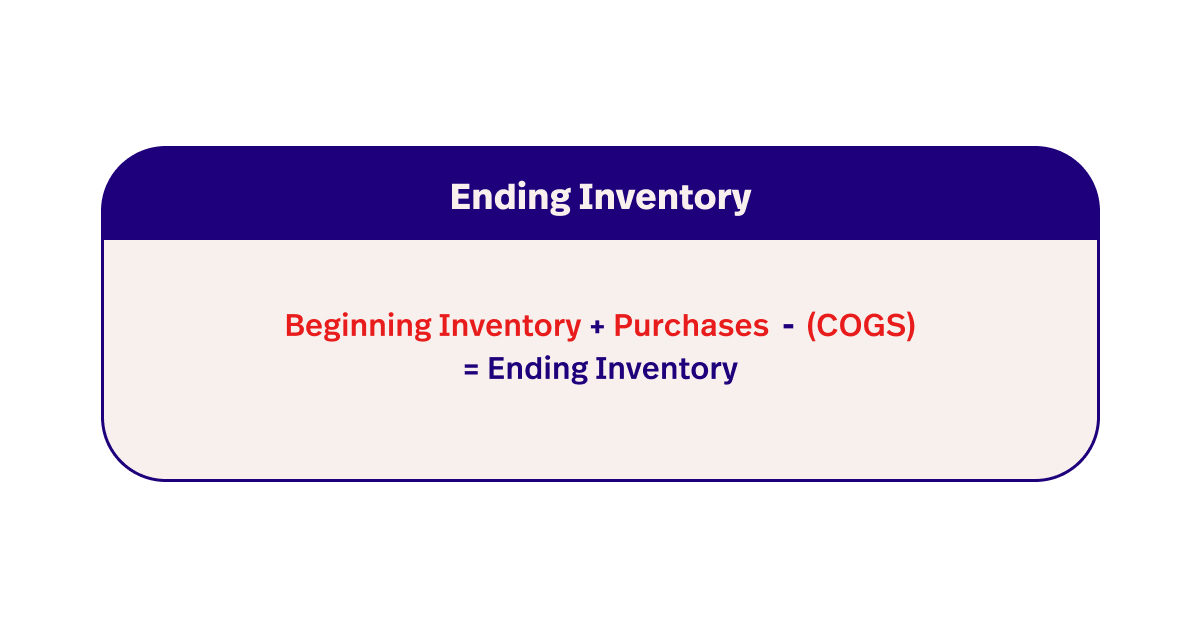
This calculation captures everything that passed through your inventory during the accounting period. Here’s the step-by-step ending inventory formula.
Step-by-step guide to calculating ending inventory
- Start with beginning inventory: This is the value of everything left over from the previous period. It’s your starting point for the current accounting cycle.
- Add new purchases: Include all the inventory you’ve bought during the period. Check your purchase orders or supplier invoices for the total cost.
- Subtract COGS: COGS is the direct cost of the inventory you’ve sold. This figure typically comes from your financial records and excludes items still unsold.
Here’s a quick example: If your beginning inventory is $10,000, you’ve purchased $5,000 worth of stock, and your COGS is $8,000, the calculation looks like this:
Ending Inventory = $10,000 + $5,000 – $8,000 = $7,000.
Perpetual vs. periodic inventory systems
How you track inventory affects the accuracy of your ending inventory numbers.
| Feature | Perpetual inventory system | Periodic inventory system |
| Tracking method | Updates inventory in real time after every sale or purchase | Relies on physical counts at the end of a period |
| Accuracy | More precise, as it accounts for shrinkage and returns immediately | Less precise, as it doesn’t track theft or breakage during the period |
| Setup complexity | Requires more setup, including software and scanners | Easier to set up, often using manual counts |
| Best for | Businesses needing real-time inventory updates, such as retail and e-commerce | Businesses with simpler inventory needs, such as small shops or periodic bulk orders |
| Impact on management | Helps manage stock fluctuations and improve turnover | Can lead to discrepancies and less efficient stock management |
The system you choose shapes not just your calculations but also how well you can manage stock fluctuations and improve turnover. Accurate tracking makes all the difference in staying efficient and profitable.
Ending inventory methods
How you calculate ending inventory matters—it impacts your financial reports, taxes and even how you manage stock. The method you choose depends on your industry and the type of products you sell. Here’s a breakdown of the most common approaches and where they work best.
| Method | How it works | Best for | Key impact |
| FIFO (First In, First Out) | Oldest inventory is sold first, leaving newer stock as ending inventory | Businesses with perishable or time-sensitive goods (e.g., food, cosmetics) | Higher ending inventory values during rising prices, boosting financial statements |
| LIFO (Last In, First Out) | Newest inventory is sold first, leaving older stock on hand | Industries with steady product lifecycles (e.g., manufacturing, retail) | Lowers ending inventory value during inflation, reducing taxable income but not always reflecting true stock value |
| Weighted Average Cost | Averages the cost of all inventory items over a period | Businesses with large quantities of similar products (e.g., electronics, hardware) | Smooths out price fluctuations, making reporting more consistent |
| Specific Identification | Tracks each item individually with its exact cost | High-value or unique inventory (e.g., car dealerships, luxury goods) | Highly precise but requires rigorous tracking, best for businesses with fewer, distinctive items |
Each of these methods has its strengths and serves different business needs. The key is to choose the one that aligns with your products, industry and financial goals.
Challenges in ending inventory calculation
While the ending inventory calculation may seem straightforward, several factors can make it difficult to determine an accurate inventory value. One of the most common challenges is inventory shrinkage caused by theft, loss, administrative errors, or vendor fraud. Damaged, expired, or obsolete products can also distort inventory values if they aren’t properly accounted for.
Timing differences can create additional complications. Inventory that has been ordered but not yet received or products that have been sold but not yet shipped can affect how businesses calculate ending inventory. Inaccurate data entry, inconsistent inventory counts, and disconnected systems can further contribute to discrepancies between recorded and actual stock levels.
To improve ending inventory accuracy, retailers should:
- Conduct regular inventory audits
- Maintain accurate stock records
- Standardize inventory counting procedures
- And use inventory management software that provides real-time visibility into inventory movements
These practices can make it easier to determine how to find ending inventory accurately and reduce costly reporting errors.
Benefits of tracking ending inventory accurately
Accurately tracking ending inventory provides valuable insights that support both financial management and day-to-day operations. Because ending inventory directly affects cost of goods sold (COGS) and gross profit calculations, accurate inventory records help businesses gain a clearer understanding of profitability and overall financial performance.
Reliable ending inventory data also improves demand forecasting by helping retailers identify
- Sales trends
- Optimize reorder points
- Avoid costly stockouts or overstock situations
With greater visibility into available inventory, businesses can make more informed purchasing decisions and allocate resources more effectively.
Accurate inventory tracking also reduces stock discrepancies, minimizes losses from shrinkage, and supports stronger cash flow management by preventing excess capital from being tied up in unsold products. Ultimately, maintaining accurate ending inventory records helps retailers operate more efficiently, improve reporting accuracy, and make smarter business decisions based on reliable data.
How ending inventory affects financial statements
Ending inventory plays a critical role in both the balance sheet and income statement. On the balance sheet, ending inventory is recorded as a current asset, representing the value of unsold goods available for future sale. On the income statement, ending inventory is used to calculate cost of goods sold (COGS), which directly impacts gross profit and net income.
For example, in an ending inventory example, if a retailer reports a higher ending inventory value, its COGS decreases, resulting in higher reported profits. Conversely, a lower ending inventory value increases COGS and reduces profitability. Because ending inventory affects multiple financial metrics, maintaining accurate inventory records is essential for reliable financial reporting, tax compliance, and informed business decision-making.
Examples of ending inventory
Retail industry
Clothing stores often deal with seasonal products, so the FIFO method is a natural fit. Imagine it’s the end of summer; older summer inventory is sold off first, leaving the newer fall stock as the ending inventory. This keeps stockrooms clear of outdated items and ensures inventory turnover stays strong.
With FIFO, ending inventory reflects the cost of newer items, which is typically higher during inflation. On financial statements, this lowers the cost of goods sold COGS and boosts gross profit. It also aligns perfectly with the rhythm of selling perishable or fast-changing goods like apparel.
Manufacturing industry
Factories producing automotive parts often use the LIFO method, especially when material costs are climbing. Why? LIFO assumes the most recent—and pricier—inventory is sold first, leaving older, cheaper materials as the ending inventory. This can be a smart way to reduce reported profits and, in turn, lower tax liabilities.
For instance, if steel prices spike during the quarter, the factory’s COGS rises too, reflecting those higher material costs. As a result, the balance sheet shows lower ending inventory values, which can reduce working capital. While great for tax strategies, this method can understate the value of remaining stock, so it’s a trade-off businesses weigh carefully.
Ecommerce business
Ecommerce stores, especially those dealing with fluctuating prices, often turn to the weighted average cost method. This method spreads costs evenly across all inventory, creating a consistent valuation.
Take an online electronics store, for example. If the same laptop model is purchased at different prices throughout the quarter, the weighted average cost ensures ending inventory reflects a fair, balanced cost. This keeps financial statements stable, avoiding big swings in COGS or net income. It’s a practical choice for businesses with high product volumes and frequent price changes.
Each method impacts how ending inventory appears in financials and how businesses make decisions. The right choice hinges on your products, costs and goals.
FAQs about ending inventory
What is the difference between beginning inventory and ending inventory?
Beginning inventory is the stock value a business carries over from the previous period—it’s what’s on hand when the accounting period starts. Ending inventory is the value of what’s left unsold at the end of the same period. Both numbers frame the inventory cycle, helping calculate key metrics like cost of goods sold and inventory turnover.
Why is ending inventory higher than expected?
Ending inventory might be higher than expected if fewer sales happened, purchasing outpaced demand or overstocking occurred. Mistakes like missed shrinkage or errors during physical counts can also inflate the numbers. To avoid surprises, regular audits and precise tracking are essential for keeping inventory figures accurate.